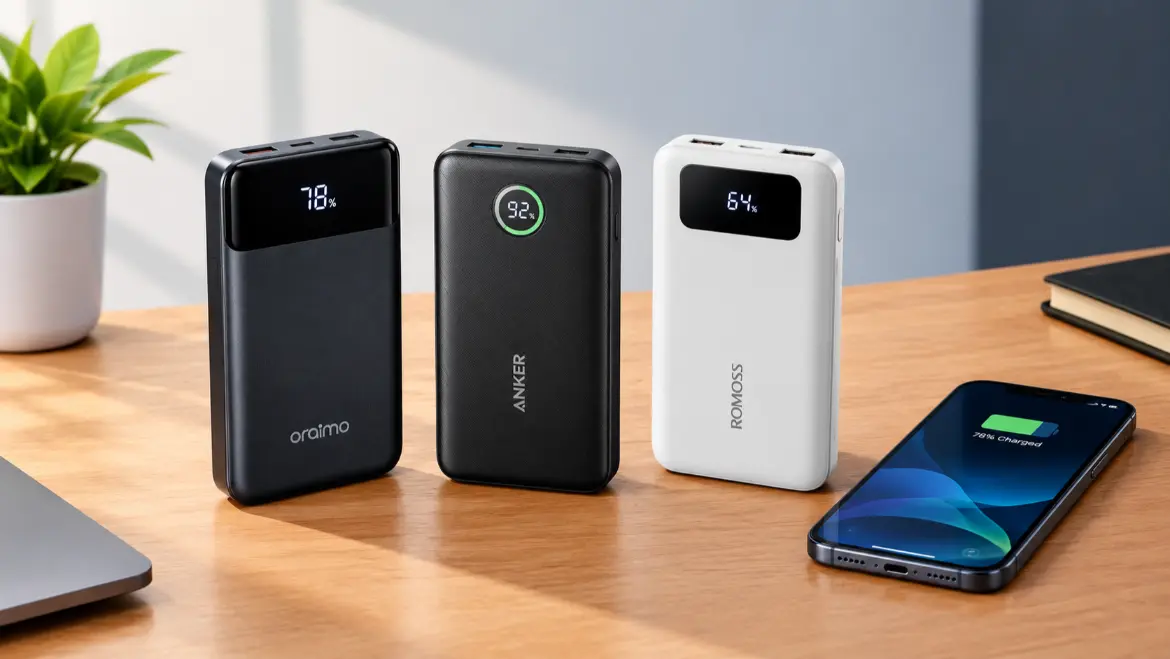
Best 20,000mAh–30,000mAh Power Banks in Nigeria: Oraimo vs. Anker vs. Romoss Price Check
With the current state of electricity grid reliability in Nigeria, a high-capacity power bank is no longer a luxury. It is basic survival gear for anyone trying to stay online, run a remote job, or keep a business moving. When you step up from basic 10,000mAh packs to the 20,000mAh to 30,000mAh range, you are investing in multi-day power that can keep a smartphone alive through extended blackouts.
However, entering this tier means navigating a market flooded with sophisticated fakes and confusing charging protocols. A high-quality 20,000mAh to 30,000mAh power bank in Nigeria costs between ₦17,000 and ₦110,000, heavily depending on the brand’s reliability, fast-charging wattage, and whether it can charge demanding devices like laptops.
Current Market Price Overview
The table below breaks down what you can expect to pay for genuine models from the top three brands in the Nigerian market: Oraimo, Anker, and Romoss.
| Brand & Model | Rated Capacity | Current Price Range (NGN) | Standout Feature |
| Oraimo Traveler 12 / 15 | 20,000mAh | ₦17,600 – ₦21,500 | Budget-friendly, reliable daily carry |
| Oraimo PowerNova Q21 (22.5W) | 20,000mAh | ₦24,000 – ₦26,600 | LED digital status display, 22.5W fast charging |
| Oraimo PowerNova L21 (30W) | 20,000mAh | ₦31,900 – ₦35,800 | 30W high-speed output for tablets & fast phones |
| Romoss Sense 8PF / Sense 8+ | 30,000mAh | ₦29,800 – ₦45,000 | Massively scalable multi-day charging, great value |
| Romoss PEA30 (30W) | 30,000mAh | ₦29,800 – ₦50,000 | 30W two-way Type-C fast charging |
| Anker PowerCore Select 20000 | 20,000mAh | ₦50,000 – ₦75,000 | High tier component durability, PowerIQ safety |
| Anker 325 PowerCore 20K II | 20,000mAh | ₦60,400 – ₦85,000 | Premium build, flight-safe design, long shelf life |
| Anker 87W Laptop Power Bank | 20,000mAh | ₦88,000 – ₦110,000 | High-output 87W for charging MacBooks and PC laptops |
Brand Breakdown: Which One Matches Your Needs?
- Oraimo: The Mass-Market King
Oraimo has established a dominant position in Nigeria for a reason: accessibility and localized warranty support. If your power bank stops working within the warranty period, you can easily walk into a Carlcare center to get it sorted.- The Reality: Their power banks feature “AniFast” technology, which safely scales up charging speeds for most standard devices. They are highly reliable for daily mobile use, though they generally lack the heavy industrial housing found in top-tier premium brands.
- Best Pick: The Oraimo PowerNova Q21 offers the best price-to-performance ratio in their lineup, giving you true fast-charging speeds without breaking the bank.
- Romoss: Maximum Milliamps Per Naira
Romoss specializes in heavy bricks. If you are looking for pure, raw capacity to survive a consecutive 3-to-4 day power outage, Romoss is usually the logical target.- The Reality: A true 30,000mAh Romoss brick is heavy, it is not an accessory you casually slip into a jeans pocket. However, models like the Sense 8PF feature excellent multi-port layouts, allowing you to top up three devices simultaneously.
- Best Pick: The Romoss Sense 8PF (22.5W) delivers incredible value, offering massive 30,000mAh storage capacities at a price point where other brands only offer 20,000mAh.
- Anker: The Premium Workhorse
Anker treats power delivery like an engineering discipline. Their price tags are high, but their internal circuitry, heat dissipation, and long-term battery cell health are unmatched.- The Reality: While an Anker power bank requires a serious financial commitment, it preserves your smartphone’s internal battery health by delivering clean, stable voltage lines. Furthermore, they are the go-to brand if you need to feed power to a Type-C powered laptop.
- Best Pick: The Anker 325 PowerCore 20K II is built like a tank, ensuring reliable emergency backup for professionals who cannot afford a sudden accessory failure.
The Math Competitors Miss: True Capacity vs. Rated Capacity
One of the biggest pain points for buyers in Nigeria is purchasing a 30,000mAh power bank and discovering it only fills a 5,000mAh phone battery three times before dying. This leads to immediate accusations of buying a fake, but basic physics is often the actual culprit.
Power banks store energy at a nominal battery cell voltage of 3.7 Volts. However, standard USB charging requires outputting energy at 5 Volts (or higher for fast charging protocols). Because energy must be conserved, stepping the voltage up from 3.7V to 5V reduces the available milliamp-hours. Combine this conversion step with minor heat losses through the charging cable, and a high-quality original power bank typically operates at around 65% to 75% efficiency.
- For a 20,000mAh Power Bank: Expect roughly 13,000mAh to 14,000mAh of actual, real-world output delivered to your devices. This translates to about 2.5 to 3 full charges for a typical 5,000mAh smartphone.
- For a 30,000mAh Power Bank: Expect roughly 19,500mAh to 21,000mAh of actual output, giving you close to 4 solid charges for a standard device.
If your power bank delivers significantly less than this baseline, you are dealing with a counterfeit unit containing degraded or sand-filled dummy cells inside.
Critical Pitfalls to Avoid When Buying in Nigeria
- Buying Based on Price Alone in Open Markets: If someone offers you a “brand new Anker 20,000mAh power bank” for ₦12,000, walk away immediately. Authentic premium components cannot be manufactured or imported at that price point.
- Ignoring the Input Charging Wattage: A massive 30,000mAh power bank requires a massive amount of energy to refill. If you buy a model that only supports a basic 10W input, you will need to leave it plugged into the wall for 15 to 20 straight hours to reach full capacity. Look for models supporting at least 18W to 30W two-way fast charging so the power bank itself can recharge quickly when NEPA or your generator is running.
- Forgetting the Laptop Wattage Requirements: You cannot charge a Type-C powered laptop using a standard phone power bank. Most laptops require a delivery rate of at least 45W to 65W. Ensure you check the exact output specifications on the back of the brick before expecting it to run your workstation.
Frequently Asked Questions
How can I verify if my Oraimo or Romoss power bank is original?
Original Oraimo and Romoss packages come with a scratch-off authentication sticker displaying a 16-digit or 24-digit security code. Always scratch this panel and verify the sequence directly on the official website before discarding the packaging. Counterfeit versions will return warning notices stating the code has already been queried multiple times.
Can I take a 30,000mAh power bank on an airplane from Nigeria?
Most domestic and international airlines enforce a strict limit of 100 Watt-hours (Wh) for portable lithium-ion batteries carried in your hand luggage. A standard 20,000mAh power bank operates at roughly 74Wh and is fully flight-safe. However, many 30,000mAh power banks push closer to 111Wh, meaning airport security can legally confiscate them at the luggage screening point unless explicitly cleared.
Why does my power bank get warm during operation?
Slight warming is normal due to energy resistance during high-speed voltage transfers. However, if the plastic outer casing becomes uncomfortably hot to the touch or begins to emit a chemical odor, immediately disconnect it from your devices. This indicates failing internal cells or a lack of proper thermal throttling circuitry.